

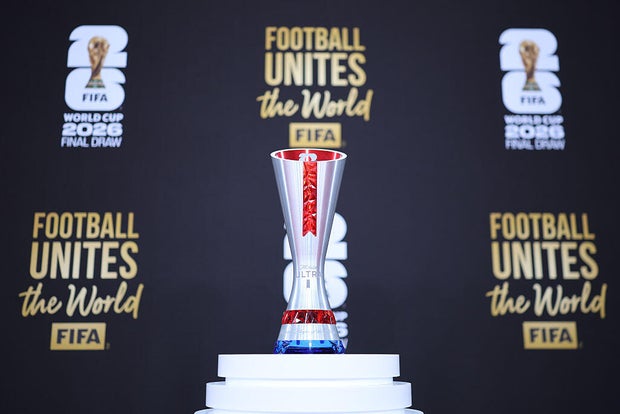
The draw will divide the 48 teams into 12 groups of four. The teams will be pulled from four separate pots, which are determined by the teams’ rankings.
Pot 1 includes the three host countries — the U.S., Canada and Mexico — along with Spain, Argentina, France, England, Brazil, Portugal, the Netherlands, Belgium and Germany.
Pot 2 is Croatia, Morocco, Colombia, Uruguay, Switzerland, Japan, Senegal, Iran, the Korea Republic, Ecuador, Austria and Australia.
Pot 3 is Norway, Panama, Egypt, Algeria, Scotland, Paraguay, Tunisia, Côte d’Ivoire, Uzbekistan, Qatar, Saudi Arabia and South Africa.
Pot 4 is Jordan, Cabo Verde, Ghana, Curaçao, Haiti, New Zealand and the six remaining playoff teams that will be determined in March.
Teams in Pot 1 will be placed in the top position of the group they are drawn into. Two teams in the same confederation — the regional groups FIFA splits international teams into — cannot be placed into the same group, except for the European confederation UEFA, which has more teams than there are groups.
During the group stage, the teams in a given group play each other in a round-robin format. At the end of the group stage, the top two teams from each group and the top eight third-place teams across all groups advance to the knockout stage.
The knockout stage is a single-elimination format, in which teams face off in a bracket format and must win in order to advance to the next round, with five total rounds: the Round of 32, the Round of 16, Quarterfinals, Semifinals and the Final.
There is also a third-place match played between the losers of the Semifinals.