

- The naira depreciated slightly in the official market against the United States dollar due to rising year-end forex demand
- The parallel market was also challenging for the naira, with traders quoting new exchange rates for the dollar, euro, and pound
- The CBN intervened in the market with $100 million in FX sales to stabilise liquidity and ease demand pressures
Legit.ng journalist Dave Ibemere has over a decade of experience in business journalism, with in-depth knowledge of the Nigerian economy, stocks, and general market trends.
Nigeria’s currency weakened marginally at the official foreign exchange market on Monday, closing at N1,451.86 per dollar, compared to N1,450.43/$ recorded last Friday.
Data from the Nigerian Foreign Exchange Market (NFEM) published by the Central Bank of Nigeria showed that the naira traded between an intra-day high of N1,457 and a low of N1,450.25 during the session.
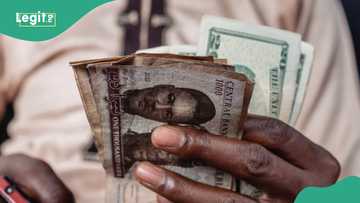
Photo: Bloomberg
Source: Getty Images
On Monday, the naira also closed mixed against other major currencies. It weakened against the euro to N1,689.17/€1, but gained slightly against the pound to N1,934.75/£1.

At the GTBank forex desk, naira slipped by N3 to trade at N1,458/$, while the black market remained unchanged at N1,465/$.
Naira performance in FX markets
The slight depreciation continues a trend of mild volatility observed in recent weeks, with traders attributing the movement to increased foreign exchange requests ahead of Christmas and year-end business obligations.
Market participants say liquidity remains stable but sensitive to shifts in dollar supply, particularly from foreign portfolio investors and the Central Bank of Nigeria’s interventions.
Analysts noted that the naira has traded within a narrow band since the beginning of December, signalling gradual adjustment rather than sharp swings.
“The market is responding to seasonal pressures while waiting for more policy direction from monetary authorities.”
Also. AIICO Capital, in its monthly report, stated volatility peaked mid-november following U.S. policy sanctions on Nigeria, triggering capital outflows despite favourable rating outlook and ongoing CBN reforms, Punch reports.
It was observed that the current pressure is a spillover from November, when geopolitical tensions and rising dollar demand slowed the naira’s previous recovery
Traders expect the naira to trade within a band of N1,443 and N1,450/$ this week in the official market, supported by improved supply and festive inflows, although year-end demand is still expected to exert pressure.
Already, the CBN has intervened with $100 million in FX sales to authorised dealers to boost liquidity.

Photo: Bloomberg
Source: Getty Images
Naira in black market
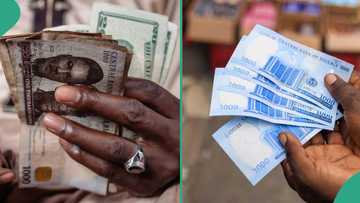
At the parallel market, the naira traded at N1,490/$, indicating a slight divergence between official and informal market trends.
Abdullahi a trader, gave the latest exchange rate as follow:
“We buy dollars at N1,475 and sell at N1,490, buy pounds at N1,965 and sell at N1,990, buy euros at N1,690 and sell at N1,725, with rates adjusting to demand”
Reserves hit $45bn
Earlier, Legit.ng reported that Nigeria’s external reserves have exceeded the $45 billion mark, reaching $45.04 billion, according to the latest data from the Central Bank of Nigeria (CBN).

This level marks one of the country’s strongest reserve positions in the past six years, matching the previous peak recorded on July 23, 2019, when reserves also stood at $45.04 billion.