

- Nigeria’s naira appreciated by 6.87% in 2025, ending years of depreciation due to CBN reforms
- Capital inflows reached nearly $21 billion, driving investor confidence and strengthening external reserves
- Moderate inflation decline is expected in 2026, with potential risks from policy lapses and FX market pressure
Pascal Oparada is a journalist with Legit.ng, covering technology, energy, stocks, investment, and the economy for over a decade.
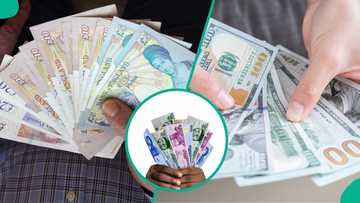
Nigeria’s currency staged a remarkable turnaround in 2025, recording its first annual appreciation in more than a decade as sweeping reforms by the Central Bank of Nigeria (CBN) reshaped the foreign exchange market.
According to a 2026 economic outlook by investment house Comercio Partners titled “Policy Shock to Structural Reset: Charting a Sustainable Economic Path,” the naira strengthened by about 6.87 per cent against the US dollar during the year.

Credit: Picture Alliance/Contributor
Source: Getty Images
The gain marked the currency’s first annual rise in 13 years, signalling a shift from prolonged depreciation to renewed stability.

The naira began 2025 trading around N1,541/$ in the official market but ended the year stronger at about N1,435/$ on December 31, reflecting improved liquidity and growing investor confidence.
CBN policy moves drive turnaround
Analysts attribute the currency’s rebound largely to deliberate policy actions by the CBN aimed at improving transparency and efficiency in the FX market.
Key reforms included the launch of the Nigerian Foreign Exchange Code, which aligns Nigeria’s FX practices with global standards and promotes transparency, accountability, and ethical conduct among banks and dealers.
The apex bank also introduced the Electronic Foreign Exchange Matching System, designed to enhance price discovery and efficiency in interbank FX trading.
These measures were built on earlier reforms between 2023 and 2024 that unified Nigeria’s exchange-rate windows and allowed the market to determine pricing more freely.
Comercio Partners noted that the reforms helped restore confidence in the system and significantly reduced opportunities for manipulation.
Read also
Naira suffers sharp fall amid rising external reserves, CBN releases new exchange rate
Stronger reserves and capital inflows
Improved investor sentiment translated into substantial capital inflows and stronger external buffers.
According to the report, Nigeria attracted nearly $21 billion in capital inflows in the first ten months of 2025, representing a 70 per cent increase compared with 2024.
These inflows were driven by higher remittances, stronger portfolio investment activity, and improved oil-related earnings.
At the same time, external reserves expanded by more than 11 per cent, strengthening the country’s ability to defend the currency during market pressures.
Domestic refining capacity also helped reduce the demand for imported fuel, easing pressure on foreign exchange demand.
Together, these factors contributed to sustained naira firmness throughout much of the year and narrowed the gap between official and parallel market exchange rates.
Inflation dynamics begin to shift
Alongside the currency’s recovery, Nigeria’s inflation trajectory began to change in 2025.
The shift was partly triggered by the rebasing of the Consumer Price Index (CPI) by the National Bureau of Statistics. The reference year was updated from 2009 to 2024, and the consumption basket was revised to better reflect current spending patterns.

Read also
Naira gets massive boost as Nigeria’s net external reserves hit four-year high at $34.80bn
Following the adjustment, headline inflation dropped from 34.8 per cent under the old base year to 24.48 per cent under the new methodology.
While the decline largely reflected statistical changes rather than immediate price reductions, it also helped reduce apparent volatility in the inflation data.
Economists say the stabilising exchange rate also played a role by easing imported inflation pressures.
After severe volatility in 2023 and 2024, caused by FX shortages, multiple exchange-rate windows, and policy uncertainty, the improved liquidity in 2025 reduced speculative pressure and helped stabilise prices for imported goods and production inputs.
Inflation outlook for 2026
Looking ahead, analysts expect inflation to continue moderating in 2026, though the pace of decline may slow.
Comercio Partners projects headline inflation to settle within 14–16 per cent in its base-case scenario, assuming policy continuity, gradual monetary easing, and a stable FX market.
In a best-case scenario, inflation could fall to 10–11 per cent if foreign exchange stability persists and agricultural output improves.
However, risks remain. Inflation could climb back to 18–22 per cent if policy discipline weakens or if renewed pressure emerges in the FX market.

Read also
Expert speaks on what US-Israeli attack on Iran means for Nigerian economy
Debt pressures remain a constraint
Despite the improving macroeconomic outlook, Nigeria’s public debt remains a significant challenge.
Debt servicing for 2026 is projected at N15.52 trillion, accounting for roughly 45 per cent of expected government revenues. Analysts warn that this could limit fiscal space for infrastructure development and social investments.
Nevertheless, non-oil revenue performance is showing improvement. By August 2025, federation revenues from non-oil sources had risen 40.5 per cent year-on-year, reflecting stronger tax administration and reforms aimed at broadening the revenue base.
Growth outlook ahead of 2027 elections
Nigeria’s economy is expected to expand moderately in 2026, with GDP growth projected between 4.0 and 4.5 per cent.
Economists note that pre-election spending ahead of the 2027 general elections could support economic activity, though this time growth is expected to be more balanced than in previous cycles that relied heavily on oil revenues.
Non-oil sectors and a gradual recovery in oil production are likely to drive the expansion.

Read also
New price emerges as Dangote Cement’s annual profit hits N1 trillion
Overall, Comercio Partners described the outlook as “guardedly optimistic.”
If reforms remain consistent and global conditions remain supportive, the progress recorded in 2025 could mark the beginning of a broader economic recovery.

Credit: NurPhoto/Contributor
Source: Getty Images
With investor confidence gradually returning and capital flows improving, analysts say Nigeria may be entering a new phase of currency stability and external strength after years of volatility.
Naira declines against US dollar
Legit.ng earlier reported that the naira continued its decline against the United States Dollar on Monday, March 2, 2026, closing at N1,378.02/$1 at the Nigerian Foreign Exchange Market (NAFEM).
The new exchange represented a N14.63 or 1.07% depreciation when compared to last Friday’s N1,363.39/$1.
The Nigerian currency also weakened against other major currencies, trading at N1,846.14/£1 versus N1,836.49/£1 for the British Pound and N1,612.98/€1 against the Euro, down from N1,609.22/€1 in the previous session.
Proofreading by Kola Muhammed, copy editor at Legit.ng.
Source: Legit.ng